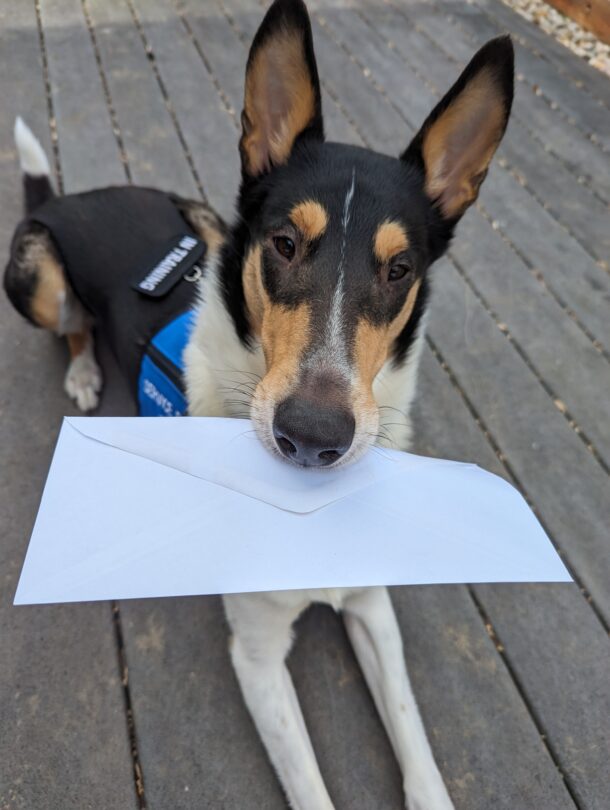
A client messages to let you know they’ve had a rough week: a flare, a hospitalization, a procedure. They’re apologetic and feel like they’ve let their dog down and are falling behind.
Health fluctuations are part of reality for many owner-trainers, but preparing clients in advance and supporting them through those periods can keep a team moving forward. With a little structure, training rarely has to stop completely.
Build a Training Plan Before It Is Needed
One of the most useful things we can do for clients is develop a training plan that accounts for these fluctuations and helps keep training moving forward. A tiered training plan is a way clients can sort their training activities into three levels: low-capacity days, moderate-capacity days, and high-capacity days.
Start by working with your client to identify training activities that require the least effort. These become the low-capacity set. Add a middle tier for steady but manageable work. Reserve more complex or physically demanding training for high-capacity periods.
The purpose of this structure is to reduce decision fatigue and help clients continue practicing at a level that is doable for them. Flexibility matters here. The plan should be easy to adjust and clients should be encouraged to adjust it as needed.
For example, on a low-capacity day a client might work a long down for one minute with reinforcement tossed to the mat, do a few reps of chin rest, mark and reinforce offered eye contact, and provide a snuffle mat for enrichment. On a high-capacity day a client might work on practicing a new task, such as a retrieve with a hold with duration, practice loose leash walking outside a local shop and take the dog on a sniff and explore walk.
This tiered approach can also support pacing, which involves balancing activity and rest to reduce the risk of symptom flare or exhaustion. This can be especially important for clients with conditions like POTS, Long COVID, and others that involve managing fatigue. Instead of training at maximum capacity on good days, clients may include lower-energy training to maintain progress without overextending themselves.
Tiered Training Plan Template
This template can be used or adapted as a flexible framework for planning training across different capacity levels, supporting both the dog’s learning and the client’s needs.
Strategies During Health Downturns
Training While Seated or Lying Down
Many behaviors can be trained while seated or lying down, including hand targeting, nose targeting, chin rests, and many platform skills. These skills are not physically demanding for the handler, and have wide applications for service dog work. Handlers can toss reinforcement when needed or use a remote treat dispenser. An in-depth look at these skills and the training mechanics needed to teach them is in Building Blocks: Service Dog Foundations.
Other simple ways to make training easier include bringing the dog up to the handler on a couch or bed. From this position, handlers can reinforce calm behavior, chin rests, eye contact, and even work on some targeting skills.
Deep pressure therapy is another behavior that works well in this context. Reinforcement can be delivered without changing position, and the handler may be able to work lying down or comfortably seated with the dog already in place.
For dogs already trained in specific tasks, practicing cues from seated or lying positions is still very useful. Service dogs need to respond when the handler is in various positions, and this is an opportunity to work on that generalization.
Focus on Mechanics
Take the time to educate clients on clean mechanics to allow them to train more efficiently and effectively in shorter time periods. Details like where and how they are rewarding the dog, and setting up training sessions so the dog offers the desired behavior quickly, can make a huge difference.
Make it Easy to Incorporate Training in Routines
Creating an environment that makes training easy helps clients follow through on harder days. Simple strategies like keeping treats in containers throughout the home and having a lightweight platform accessible can make it easier for clients to practice.
Even with the best preparation, some days training simply isn’t possible. Reminding clients that it is okay to take a short break of a few days or weeks can reduce stress and guilt. Additionally, have a plan for outside support options if needed.
Bring in Support When Needed
External support can help maintain progress during longer or more significant health fluctuations. Day training and board and train allow a trainer to work directly with the dog on specific skills. A professional can maintain or advance those skills more efficiently.
Trainers can incorporate basic training around the home in way that family members or caregivers can reinforce easily. For example, place sticky note on a table with treats that says, “cue down and reward.” Or next to a light, “cue Luna to turn this on.” Caregivers are often managing a great deal already, so these need to be skills that the dog knows well but benefits from practice, and that will take less than a minute for the caregiver to cue and reward.
Virtual coaching is another way to facilitate support. You can observe, adjust mechanics, and keep the plan moving. That regular connection can both support progress and be empowering for your client.
Address the Emotional Reality
Guilt is one of the most common barriers for owner-trainers during health fluctuations. Clients may believe they have lost significant progress or failed their dog. In most cases, that is simply not true. For many dogs, especially adolescents, slower periods can actually help by taking the pressure off and allowing time for the dog to mature.
Final Note
Ideally, owner-trainers are working consistently with their dogs, but in the real world chronic illness flares and health downturns often do have an effect. When training plans are structured thoughtfully, progress does not depend on ideal conditions. Adjusting training plans to the handler’s capacity helps keep the dog learning, engaged, and supports the team’s success.