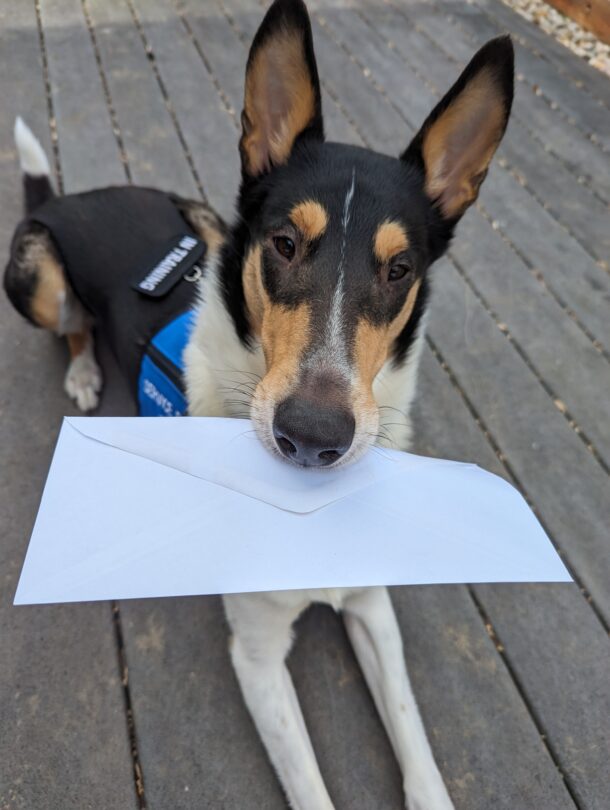
Whether it’s navigating a tight space next to a wheelchair, standing behind a handler with PTSD to perform “blocking,” or lying under a chair in a crowded coffee shop, service dogs need to move their bodies with precision. One of the most invaluable tools for training these behaviors is the platform.
What Is Platform Work?
Platform work involves teaching a dog to place their paws or their body on a raised surface. The dog may be asked to stand, sit, lie down or even move on the platform, depending on the specific goal. Platforms can be anything from a stool or a balance pad to commercial products like the KLIMB. They can even be home-made with foam or mats. Platforms are often used for canine conditioning and physical therapy, as well as in training contexts. Targeting a platform is a foundational skill that also supports many service dog tasks and public access behaviors.
A combination of luring and shaping can be used to train dogs to stand on platforms. An approach I have often used with a long platform looks like this:
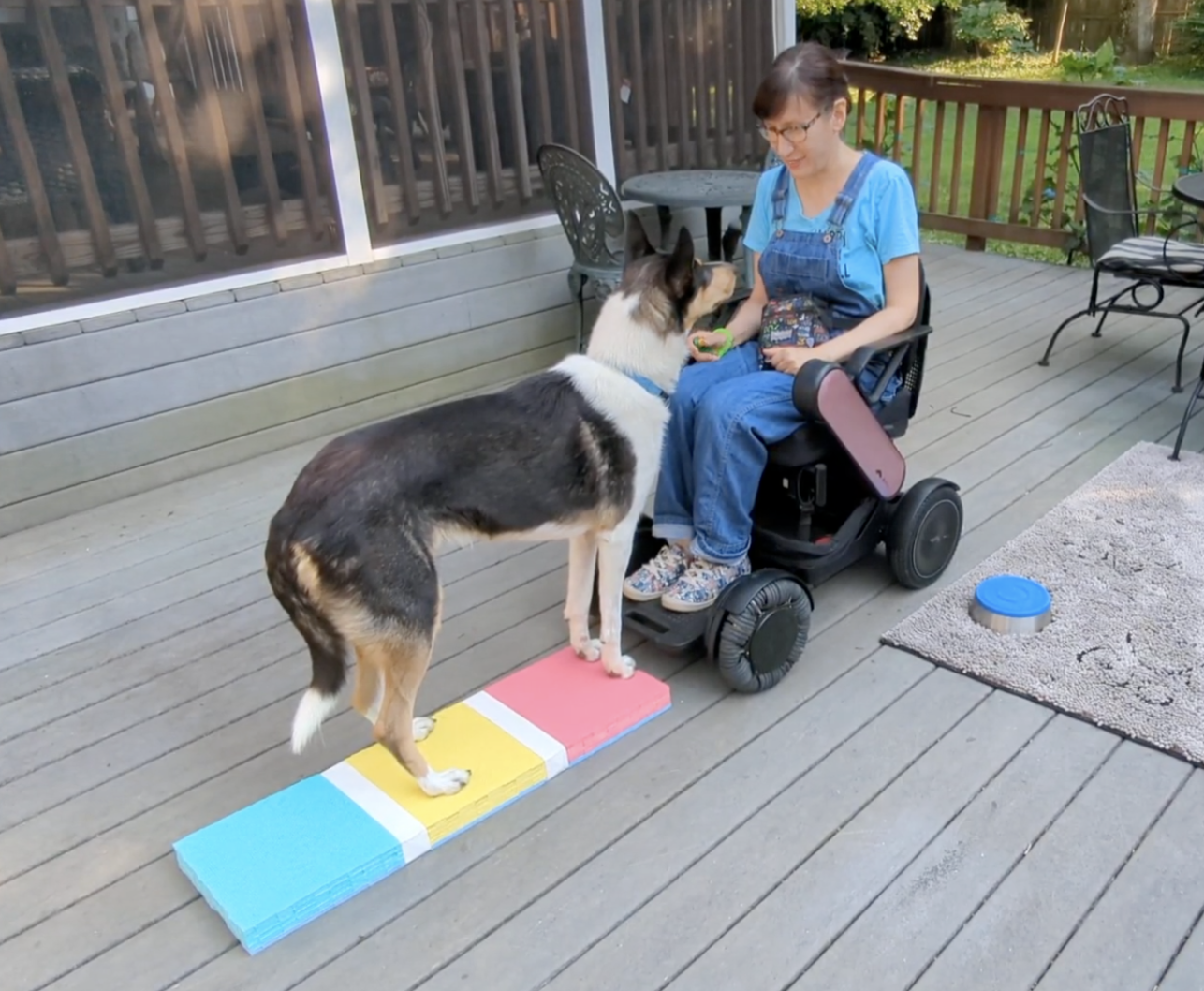
- Lure the dog onto a large platform and stand in front of the platform. Click and deliver the treat when the dog is on the platform.
- Continue to click and treat several times in a row when the dog is standing on the platform.
- Toss a treat to prompt the dog to move off the platform and then wait for the dog to get back on it. Most dogs will quickly get back on the platform since you are continuing to stand in front of it.
- Click and treat when any part of the dog is back on the platform. If any foot is not on it, use shaping to incrementally work toward marking and rewarding only when the dog is fully on the platform.
- Periodically toss treats away from the platform to get the dog to move off.
- When the dog is readily offering standing on the platform, transition to working with a smaller platform. I find it helps to teach dogs to stand on platforms with their front feet, back feet and all four feet so you have options for various training purposes.
Uses of Platform Work in Service Dog Training
Positioning and Orientations
Platforms can be used to help dogs learn to position themselves safely next to their handler. Service dogs may need to walk in front of, beside or behind their handler. If the handler uses adaptive equipment, they may be limited in their ability to lure the dog from one orientation to another. By adjusting the platform’s position, trainers can prompt dogs to stand in various orientations relative to their handler. Additionally, handlers can practice cuing the dog to transition from one position to another, for example from standing by their left side to standing behind them.
Positioning for Leash Walking
Long platforms can be used to help teach service dogs to walk parallel to the handler, and prevent the dog’s hind-end from swinging out away from the handler. This level of precision is needed when the team works in tight environments, to avoid the dog bumping into other people, objects or merchandise.
Trainers can begin by rewarding the dog for standing fully on a platform that is the length of the dog’s body and wide enough for the dog to stand on comfortably, but not so wide that the dog can turn or stand at an angle. It’s typically easiest to stand facing the dog first, before changing position and then working on either side of the dog (to replicate the positions needed when walking on leash). Dogs tend to want to turn their entire body to get the treat, and the platform helps the dog remain parallel to the handler. As with any other training strategy, stop and go back to facing the dog and delivering treats if the dog struggles when you change position.
Pivots and Tight Turns

Many public spaces are narrow, requiring service dogs to navigate tight turns. Dogs turning next to a wheelchair need to remain behind the point where the wheelchair turns (the pivot point) to avoid being hit by the chair. Circular platforms are useful for this skill. Begin by teaching the dog to stand on the platform with their front paws. Then train them to move their hind legs while keeping their front feet on the platform—this can be shaped or lured. Finally, place the platform just behind the wheelchair’s pivot point and practice turning alongside the dog as they move their back feet.
While most handlers work primarily with the dog on one side, training both sides is important. Clients may find themselves in situations where the dog needs to change position. Practicing in various positions is also good for the dog’s physical health.
Walking Backward and Forward
Platforms can serve as targets for teaching dogs to move both backward and forward. After the dog knows how to target their back and front paws to the platform on cue, the handler can slowly increase the distance between the dog’s starting position and the platform, resulting in a dog who learns to move back or forward increasing distances to reach the platform. Then the platform can gradually be faded to generalize the skill.
Training Tasks
In addition to facilitating training positioning, platforms are excellent tools for teaching a variety of service dog tasks, as well as other important skills:
- Body block / make space: Platforms act as targets to help the dog move to precise positions around the handler.
- Pulling: Combining a back-up cue, platform targeting and holding a tether can help introduce pulling. Platforms can serve as targets to guide the dog’s direction when opening doors or drawers.
Teaching Stillness: Training Stays
Platforms serve as a visual boundary, making stay training clearer for both the handler and the dog. Additionally, working with a platform can help handlers who use wheelchairs, scooters, rollators or other adaptive equipment avoid accidentally touching the dog during stays.
Working with Platforms in Different Settings
Platforms provide a familiar “safe base” in new environments, helping dogs feel secure when exposed to distracting or crowded settings. Additionally, sometimes skills get sloppy around distractions, and adding the platform back to the training process in a new environment can facilitate generalizing the behavior more precisely.
Public Access Positioning: Go to Place, Go Under and Settle
Platforms are also terrific for public access behaviors. Short platforms can be used as targets for positioning under tables or chairs. They can even facilitate training the long down service dogs need in restaurants and similar situations. Platforms can be awkward to take to new settings, but placing a mat on the platform can help transfer the behavior to the mat. Once the dog understands the long down on the platform with the mat, the mat can then be used to generalize the long down to other environments. The mat can eventually be faded out or continue to be used if it is more comfortable for the dog.
Types of Platforms
Stools and Small Foot Targets
Portable and easy to use, small stools and stackable steps help teach positioning and hind-end awareness. Upside-down food bowls can serve as circular platforms, and balance pads are also useful.
DIY Options
Foam floor tiles can be stacked and taped with duct tape to create platforms of various sizes. Yoga mats can similarly be cut to create platforms for training tasks.
See video demos of platform training here and here.
A Simple Tool for Complex Tasks
Platform work is more than a simple targeting exercise—it’s a foundational tool for building precision, confidence and reliability in service dog teams. By simplifying complex positioning tasks and providing clear boundaries, platforms help dogs perform safely and efficiently. Integrating platform training early, and revisiting it throughout a dog’s working life, can make a significant difference in skill, confidence and overall team success.