Selecting a Breed for Service Work
In the service dog community, the phrase the “Fab Four” is used to refer to four breeds often chosen for service work:
1. Labrador Retrievers
2. Golden Retrievers
3. Standard Poodles
4. Collies
Labrador Retrievers (in particular English/show lines) are widely chosen by service dog programs for good reason. Many individuals of this breed have the temperament, energy level and physical traits required. Working or field-bred Labradors often have energy levels that are too high, although they may be good choices for a very active individual.
Golden Retrievers and Lab-Golden crosses are also commonly selected for this work. However, Goldens have a high rate of cancer, and some can be environmentally sensitive to the point where public access work isn’t realistic.
Standard Poodles and Collies can be excellent service dogs, but both breeds can be sensitive. Sensitivity is not usually an asset for service work. Dogs that are sensitive may be startled, overwhelmed or stressed by the pressure of working in varied, complex settings. Additionally, I have noticed many Standard Poodles have significant food sensitivities and are prone to IBD. Aside from impacting health, these conditions can make training difficult and sometimes nearly impossible.
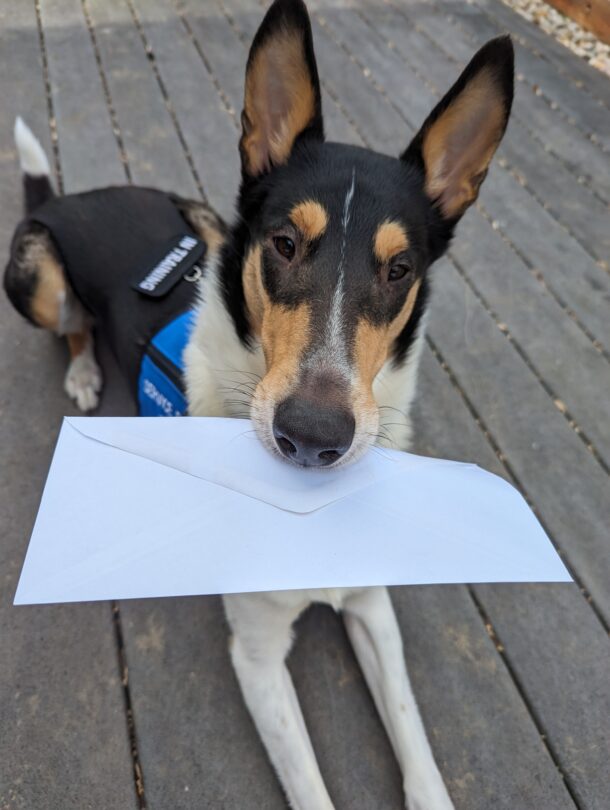
Collies are my personal breed of choice as an owner-trainer with a mobility disability. They are the size I need to do tasks and, even during their adolescence, they tend to be careful with their bodies and less likely to cause me to fall. However, they are much more sensitive than most Labradors, in particular being prone to sound sensitivities. They are more likely to be environmentally sensitive and some have a high energy level. Like many service dog handlers, I have Smooth Collies given their reduced grooming needs.
Poodle crosses, like Goldendoodles and Labradoodles, vary widely in their behavior, physical characteristics and health. However, many are now being successfully worked with in service work, and more service dog training programs are incorporating them into their breeding efforts.
Should Owner-Trainers “Go Outside of the Box”?
Owner-trainers sometimes choose breeds that are less commonly selected for this work. In some cases, these choices are strategic and can work well. For instance, a disabled owner who lives in an apartment or has limited access to outdoor space may find it easier to care for a toy breed dog. Other times, owners choose simply based on personal preference. In some cases, an “outside of the box” breed will work well as a service dog. However, genetics matter. Choosing a hound, terrier or guard breed that has been bred to work independently — or bred to exhibit behaviors that are undesired in service work — makes it less likely that the dog will succeed in the work.
Some service dog programs opt to work with dogs out of shelters or rescues rather than purebred dogs. Programs that succeed with rescue dogs often have:
- Access to large shelters or rescues that allow dogs to be screened and held for evaluation
- Foster homes to raise and re-evaluate candidates
- Access to veterinary health screening
Most shelters simply aren’t set up to support this, and the logistics make selecting a shelter dog a riskier option for owner-trainers. Also, in reality, dogs with service dog potential are often adopted quickly because they make lovely pets. This of course does not mean that there are not wonderful shelter dogs that successfully work as service dogs, only that there are some challenges to the arrangement.
Real-World Dog Selection for Owner-Trainers
There are a variety of behavior assessments professionals use to evaluate dogs; however, many have minimal research supporting them or have other barriers that make implementation difficult. While service dog professionals often rely on screening tools and evaluations, owner-trainers and professional trainers supporting them face logistical challenges in implementing these techniques to help with their dog-selection process:
- Reputable breeders may live far away, making it logistically challenging to assess a large enough number of dogs.
- Prospective handlers may be unable to travel, eliminating their ability to assess dogs in person.
- Breeders often wait to assign puppies to show homes first, leaving few choices for those seeking a service dog candidate.
Research on puppy temperament testing has not shown that structured evaluations are predictive of success in service work. Some formal tools like the Behavior Checklist have supporting research but are complex and designed for larger programs. Some professional trainers have breeders they network with in order to be able to access service dog prospects. However, oftentimes, trainers are in the same position as owners, with limited access to litters and logistically not able to implement a behavior assessment to assist in selecting the dog.
Sometimes, simply observing the dam and sire — or other adults from the breeder’s lines — may be more meaningful. Trainers can help owners by offering easy-to-follow guidance, such as:
- “Do the dogs approach you or avoid contact?”
- “Does the puppy tolerate handling calmly when picked up?”
Since the service dog industry lacks formal standards, even asking whether a breeder’s dogs have worked in service roles may not be meaningful. Still, successful therapy dogs in the lines can suggest a solid temperament.
Owner-trainers can improve their odds by:
- Verifying health testing on the OFA website
- Asking about temperament history and pedigrees
- Talking to multiple breeders
- And ultimately… crossing their fingers
A Note on Breeder Hesitation
Some breeders are understandably cautious about placing dogs in service homes. They know most dogs are not suited for the work and want their puppies to live happy, low-stress lives with satisfied owners.
Prospective handlers should be honest about their goals and have a plan if the dog turns out not to be a fit. Most choose to keep the dog — and letting the breeder know this can be reassuring.
If an owner doesn’t plan to keep the dog in the event the dog needs to be career-changed, this needs to be discussed early and in a way that prioritizes the dog’s welfare. Breeders also appreciate knowing how the owner plans to meet the dog’s needs and keep them happy throughout their lives.
Stacking the Odds in Your Favor
Selecting a service dog candidate well requires a combination of knowledge and experience in dog behavior and a significant amount of luck. While no dog is perfect, understanding behavior traits, breed tendencies, and the realities of sourcing and raising a candidate gives owner-trainers and professionals the best chance of success. With thoughtful planning, honest conversations and a commitment to the dog’s wellbeing, it’s possible to increase the odds of choosing a dog who is highly trainable and enjoys the challenge of working in public access.