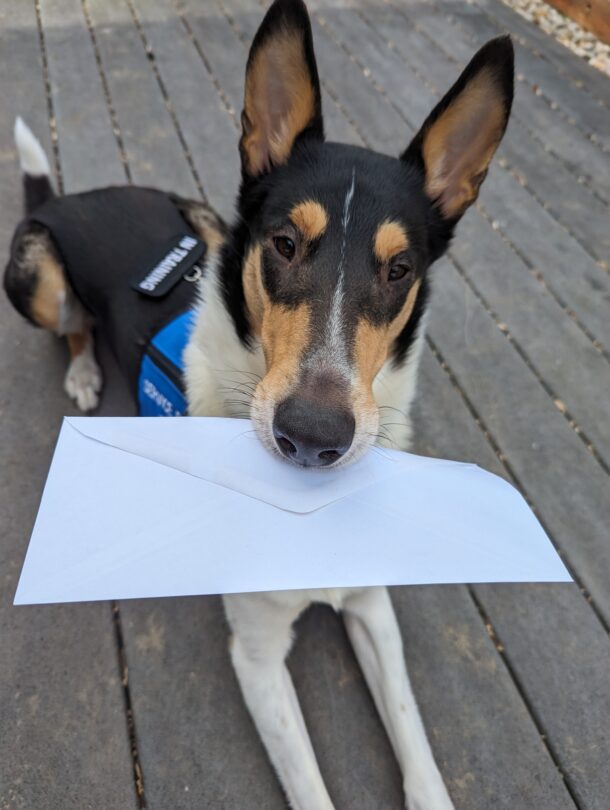
Every service dog task carries some risk. Even with a simple retrieve, the dog might pick up something sharp and injure their mouth or drop and damage an important item. Some risks are more obvious than others. For example, helping the handler get up from a fall, or failing to perform a medical alert can carry significant consequences.
The good news is that most risks can be reduced or mitigated. For instance, for a diabetic alert the handler can also use a recommended medical device such as a Continuous Glucose Monitor. Many times there are alternative tasks that are less risky and can still be helpful. For instance, a dog can bring a chair, cane or walker closer to the handler after a fall, rather than having the handler directly lean on the dog to get up. When working with clients to select and train tasks, weighing potential risk is an important part of the conversation.
Start With an Assessment
When selecting tasks, here are several important considerations:
- What are the potential risks to the handler, the dog, and anyone else nearby?
- How can the effectiveness and safety of the task be assessed? In some cases this is simply through direct observation, but in other cases assessment is more complex.
- What does objective research say about the task? Can dogs do this reliably and effectively?
- What are the consequences if the dog fails to perform the task as intended?
- Are there ways to reduce those risks, such as technology, redundancy, task modification, or established medical tools and devices that could be incorporated with the use of the service dog?
By taking time to assess these aspects, service dog trainers and their clients can consider the risks and benefits fully and choose the tasks that will be both most effective and also safe for all involved.
Three Examples
1. Scent-based medical alerts
The consequence of a missed medical alert to a blood sugar change, an allergen, a seizure or other medical event can be serious. Additionally, the evidence supporting dogs’ ability to reliably alert to various medical situations is in some cases non-existent and in other cases conflicting. Dogs performing reliably at identifying odors in a controlled lab setting is not the same as a dog doing this work in a live service dog context. A dog alerting to scents in an airport has many context cues and is also cued to look for the target odor by the handler who is closely watching the dog. Even in those cases, reliability is not perfect. In most service dog work, on the other hand, the handler is not focused on the dog’s medical alert, the handler is just going about their life. The dog is expected to be always ready to alert: the presence of the target odor is the cue. The research simply hasn’t caught up to the demand for scent based medical alert tasks.
That said, clients often want scent based alert tasks and for good reasons. Even some medical devices are not always reliable and, in some cases, may not exist. Reducing risk may involve multiple layers such as incorporating smart technology, and using medical devices, medically recommended management strategies in addition to the service dog’s alert. Learn more about how smart technology can be incorporated into service dog training on the blog.
Trainers can also take steps in the training process to help reduce the odds that the dog is responding to inadvertent handler cues (Clever Hans effect) rather than the target odor. Trainers can test under conditions where the trainer does not know whether the odor is present. Additional safety measures include incorporating the healthcare provider’s feedback into the task selection process.
Lastly, solid response tasks can be trained. These are tasks performed after the event, for instance retrieving medication, an emergency phone or lying down next to the handler when the handler falls. Response tasks are often treated as the less exciting sibling to alerts, but in some cases they carry more real-world value, with far less uncertainty.
2. Balance and brace work
This category of tasks poses risks to both handler and dog. It’s physically demanding for a dog, and if the dog fails, the consequence to the handler can be serious. I have a mobility disability myself, so I understand the appeal of this task on a personal level. But after talking with rehabilitation professionals (more than a dozen, over the course of decades), my overall position is that in most cases medical devices are a safer option.
There are occasional exceptions. Sometimes if the handler places their hand lightly on the harness, their gait improves due to the proprioceptive input. For some individuals this can happen without any actual downward pressure being applied. If you are going to work with a team on brace and balance tasks, trainers should work in communication with the client’s vet (ideally a veterinary orthopedist) and the client’s healthcare provider; a rehabilitation professional such as a physical or occupational therapist is ideal. The communication should cover not just whether the task is trained, but how, since the details can determine whether the task is effective and safe for both members of the team.
In other cases, it’s best for the team to look at different ways for the dog to help. Alternatives can include having the dog retrieve adaptive equipment, a phone or perform the next task on the list: alert a caregiver that help is needed.
3. “Go get help”
There are two versions of this behavior. The first one is a task performed at home, where the dog alerts the caregiver that help is needed. This task does not involve many risks. The second version, having the dog alert an unfamiliar person in public, is another thing entirely.
The most widely known version of this task traces back to a post that Snopes examined as a viral claim about a service dog trained to seek out a stranger when its owner is having a medical emergency, ultimately rating the claim “mostly true” while noting that not every service dog receives this kind of training. What often gets lost in the retelling is that the team behind that original incident was owner-trained (no mention of professional guidance of any kind) and that the stranger the dog approached “swatted” at the dog.
In a public setting, sending a dog to “get help” depends on unpredictable human behavior and environmental variables outside anyone’s control. The dog could wander into a street, encounter traffic, or encounter an individual who responds inappropriately toward the dog, as happened in the case described above. A random stranger may also not respond appropriately to the handler themselves. It’s common for people not to know how to react to someone having, say, an epileptic seizure, and to think they need to restrain them in some way, which is unsafe for everyone involved.
Fortunately, for the public-setting version of this task, various versions of smart technology exist that can allow handlers to get qualified help without putting the dog’s safety at risk. An alternative behavior, training the dog to lie down next to the handler, is, in most cases, a safer behavior for the dog and positions the service dog to be ready help as soon as the handler is able.
Conclusion
Although almost every task carries some risk and trainers may not be aware of all the possible options. Service dog trainers can support better decision-making by working in communication with qualified healthcare providers and veterinary professionals when needed. Selecting tasks is not just about whether a dog can perform a behavior—it is about choosing tasks that are effective, appropriate, and as safe as possible for both the dog and the handler.