
Looking for Turtles?

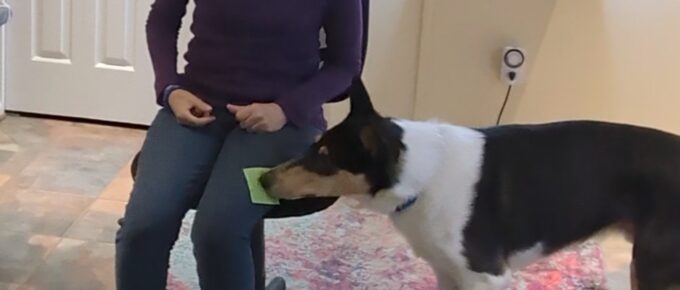
So what’s the coolest thing you’ve ever trained a dog to do? I would love to be able to tell you it was something I did yesterday, but honestly, my favorite trick ever was one I taught one of my dogs as a child. I had this lovely labrador mix and I taught him to find box turtles. I don’t remember my “method” in detail, but I remember that enthusiasm was a big part of it. No punishment was involved at all, and the reward was my super exuberant praise -plus finding a turtle!

We had a box turtle in our yard, and it would hide and of course I wanted to check it out periodically. So I would tell my dog, “let’s find Henrietta” (that was her name) and we’d start looking. After a few weeks, I noticed all I had to do was say “let’s find Henrietta” and he would look for me and he’d carry her back to me in his mouth. He never injured her and we always put her back carefully where we found her – I would leave a few fruits and vegetables too in case she was hungry. We did not set up any training sessions to practice. I genuinely was looking for the turtle when I taught him. Over the years, this skill generalized and of course, Henrietta eventually wandered off our property. In our hikes in the woods and neighborhoods it would randomly occur to me that it would be nice to see if any turtles were around. So I’d tell him to “go find Henrietta!” and sure enough, he would look for a turtle and often would find one if we looked long enough.

Eastern Box Turtle

Nowadays, training dogs, like so many other things, has become a bit of a chore. Many people are worried about “messing up” their technique and the joy in the process is gone. I find myself reminding my clients to “have fun” and to be willing to experiment with using your voice, showing your dog yourself, praising your dog a lot. It’s ok to not always be 100% analytical about your technique – keep it fun for yourself and your dog too!

Posted in Dog Training, Human-Animal Bond | Tagged , | 1 Comment

Your dog’s health and his behavior

Fielding emails from prospective clients, I typically encounter several each week where the owner is absolutely positive that their dog’s problems are 100% behavioral in spite of the fact that they have not ruled out the possibility of a medical problem. Just because their vet gave their dog a few vaccinations, does not mean that their dog is healthy. The annual office visit with a vet is usually a very general, brief exam. Unless an owner specifically tells their vet that the dog has a behavior problem and they want to rule out possible medical causes, the veterinarian will not know that they need to run additional tests. So to give a human analogy, if you go to your general practice doctor and tell him that everything is normal, he may not feel the need to run bloodwork to identify possible problems with your thyroid. Similarly with dogs, thyroid problems are well known to be associated with dog behavior problems but most veterinarians do not routinely run comprehensive thyroid panels as part of the general office visit. Any medical condition can impact a dog’s behavior, I have had clients whose dogs developed behavior problems and were shortly thereafter diagnosed with conditions like cancer, renal failure, lyme disease and even more minor conditions such as urinary tract infections.

So in short, if your dog has a behavior problem, please do take the time to inform your veterinarian. Your dog will thank you for it!

Posted in Dog Behavior | Tagged , , , | Leave a comment

Gardening and Dog Ownership

So gearing up to do a little gardening. Got to thinking about things that gardening and living with dogs have in common:

1. Most of the time, the amount of work you put in reflects what you will get back. That said it is possible to over do things and under do things.

2. You need to plan ahead and choose the right match for your living environment. If you don’t, it is always going to be a major challenge no matter what you do. If you do make the right choice, things will be  easy!

3. Sometimes, things happen that are beyond your ability to control and it is best to just have a good attitude about it and accept it as part of life.

Any other ones gardening fans/pet owners? Hope everyone is enjoying their summer!

Dogs in front of a garden.

My canine pack posing in front of my garden.

Posted in Human-Animal Bond | Leave a comment

The right match: Researching Shelters and Rescue Groups

There are several different venues to find a shelter or rescue dog or cat including:

1. Animal Shelters

2. Non profit rescue groups

3. Breed specific rescue groups

4. Direct individuals- for instance Craig’s list, random people rehoming their pets.

When it comes to getting a pet directly from an individual, it is important to realize that  acquiring an animal from a total stranger entails risk. As much as is possible, I suggest getting information in writing – and do this even if you know the person you are getting the pet from. For instance, make sure that the dog/cat really did belong to the seller. Get copies of veterinary records, require a receipt or some type of written proof that ownership is being transferred to you. If the person is offering to take the dog/cat back should the placement not work out, get this information in writing up front.

Animal shelters and rescue groups/organizations vary tremendously in their procedures. Animal shelters may have qualified animal behavior professionals on their staff who assess the animal’s temperaments and behavior prior to adopting them out. The more you know about the animals’ behavior and temperament the more likely you are to find the right match.

Monty, our beautiful and clever mixed breed from a DC area shelter enjoys a snow fall!

Before adopting the pet, look into the shelter/rescue organization itself:

1. Does the shelter/rescue group conduct some type of temperament or behavioral assessment? Ask to see a copy of the assessment.

Please keep in mind that a statement like: “Dog is friendly, loves to play” is not sufficient information. A behavioral assessment that is merely based upon the information given by the foster is also not sufficent (unless by chance the foster happens to be a qualified animal behavior professional too). People who foster animals are often highly experienced animal owners. Therefore what may be a major problem to a pet owner, may be “no big deal” and “not even worth mentioning” to a foster. Additionally, it takes anywhere from 4-6 months for a dog to show its true temperament and behavior in a new setting. One of the most common calls I get is the new adopter who was told that the dog loved other dogs in the foster home but, surprise, surprise, the dog is showing some dog aggression now after a few weeks in the new home.

While behavior can change and there are no guarantees when it comes to an animals’ behavior, a formal behavioral assessment by an experienced, qualified professional can help in matching the right dog with the right owner. Ask about the qualifications of the individual conducting the assessments (what is their experience/formal training in the field, what industry credentials do they have, are they a CPDT or a CDBC/CABC)? A behavioral assessment can help provide adopters with as much information as possible and help organizations make the best possible matches.

That said, not all organizations have the resources to conduct assessments like this. If they do not  and you would like to adopt a pet from them, I suggest hiring a qualified professional trainer or behavior consultant to conduct an assessment of the pet for you.

2. What is the organization’s policy regarding animals that have a history of behavioral problems? Does the organization adopt out animals that have bitten/injured people or other animals?

Some rescue groups simply do not accept animals that have a history of aggressive behavior. Other organizations may try to train or modify the animal’s behavior prior to placement and/or place the animal in a highly qualified home with some stipulations (i.e. no children in the home, adopter is informed of the animal’s behavioral history and is required to follow up with a behavior professional).  Some organizations may disregard the animal’s aggressive behavior history when placing the animal. Be prepared to ask direct questions, you should be aware of the organization’s policies so you can make an informed decision.

3. What does the organization require/expect from adopters? Ask to read the adoption contract and review their policies very carefully. If the organization has many requirements or has a wait period prior to adoption, that is not necessarily a “bad” thing.

4. Research the organization itself, and make sure that it is a legitimate organization. Non-profit organizations can often be verified by researching the State department of commerce (online). Look to see evidence of non-profit status.

A pet is often a decade (or longer) commitment.  Taking your time to learn as much as possible about not just the pet but the organization that you will be adopting from can help stack the odds in your favor for finding just the right match for you.

Posted in Choosing a Dog | Tagged , , , , | 1 Comment

Finding the right match from a breeder

Lately, I’ve been thinking more and more about some of my clients who are really mis-matched with the purebred dog they have chosen. It is a struggle for both the owner and the dog, and while certainly I can help them learn to better understand, communicate with and live with their pet, it is never going to be smooth sailing. For instance consider a really high energy dog with a low-energy person, a vocal dog in an apartment living situation, a dog-aggressive dog living in an urban setting where close proximity with other dogs is unavoidable-no way will these be easy situations!

While yes, within breeds there can be many differences (considering how different my own two smooth collies are!), genetics does matter. So I looked over breed club and breeder individual websites to see breed descriptions.  As I looked I noticed that most breed club websites have very little space devoted to temperament and behavior-arguably the most important thing a prospective puppy buyer needs to know.  And wording is very vague. Common terms: “intelligent,” “energetic,” only rarely will you get a bit of a clue about some “not so nice stuff” about the breed and even that is vague. Some of the breed rescue websites are better-and a number include pages with information on “is this the right breed for you,” but if someone is choosing a new puppy from a breeder, they will not be looking at breed rescue websites.

smooth collie puppy

Louie was an adorable puppy, finding just the right puppy from a breeder can be a challenge.

The problem is not that the sites are lying or misrepresenting their breeds, but they really aren’t providing enough detailed information on behavior/temperament. For instance, the term “energetic” often really means “most members of this breed need an opportunity to run in an open space at least a couple hours a day and if not they will be a total spazz and drive their owners crazy!” Ok, may be they may want to say it in a nicer way than that, but the term “energetic” isn’t really coming close to cutting it.

“Protective” is a term that is my personal pet peeve. Dog trainers know that “protective” (and “aloof,” “serious,” “devoted” too for that matter) is often a term that is used as a nice way of saying “some members of this breed may show aggressive behavior to unfamiliar people in/around the home.” Pet owners do not however fully understand that is what the term “protective” often means. A breed like this we want to be very sure does not end up in a home where pet owners are not prepared to introduce visitors carefully and heavily socialize the dog to boot.

Supposedly, if pet owners go to responsible breeders then they will be educated by the breeder right? Yes, some breeders do a really amazing job of educating their prospective puppy owners. But in the real world, not all breeders are created equal–and sometimes it really isn’t the breeder’s fault per se. Most breeders are not professional dog trainers, they do not routinely work with novice pet owners so they aren’t really aware of what a novice pet owner’s lifestyle, challenges and expectations are actually like. In fact, breeders often live in rural areas and spend lots of time with dog-savvy folk. So an urban prospective puppy buyer who calls a breeder saying “yeah I have had dogs before” (meaning they grew up with them-so really their parents raised dogs they just played with and lived with) and “I am very active and will hike a lot” (translates to hikes only in nice weather, only on weekends, three seasons a year) ends up being happily sold a very high energy dog to live in a high rise in an urban setting.  Situations that an experienced breeder would have no problem handling, may be a major problem for a novice pet owner. Additionally, breeders who live with breeds that are more likely to show aggressive behavior often themselves have a higher threshhold for aggression. They see a lot of the behavior as normal dog stuff-and may manage a situation differently and have different expectations. They may mistakenly assume that their buyer will be the same way – in short what to a breeder is common sense may in reality may not be.

Ultimately it comes down to prospective puppy/dog owners should absolutely not be relying on the internet or even conversations with breeders as their sole research. They need to delve beyond the surface to learn both the pros and the cons of their individual breed. Also because each breed has individual lines of dogs that may have their own tendencies, to really find the right match, an owner needs that information as well. My smooth collie, Louie, is a much less energetic dog than my adorable Firefly. Adding to the fact that really responsible breeders often have a wait (because they do not breed that frequently), it is a lot of work! It has never taken me less than 6 months to acquire a puppy from a reputable breeder and it has always taken me more emails/phone conversations than I have ever been able to keep track of.

Smooth collies sleeping

Firefly and Louie enjoy their nap on the couch. While both of these dogs are smooth collies, they have very different temperaments, personalities and energy levels. Within each breed there is variability.

A novice owner looking for a purebred dog from a breeder needs to make sure they look at information from a wide array of sources. There are a variety of books out there that give some excellent information on dog breeds including the pro’s and cons. I really like Darlene Arden’s book, “Small Dogs, Big Hearts” breed descriptions on the toy breeds. Many dog trainer/consultants (including me! ;o) do offer services to guide prospective puppy buyers in their puppy/dog purchase. Trainers/consultants by definition, tend to see people who are having problems with their dogs. As a result, we can offer a prospective owner a different level of insight. Yep, this might cost a little money, but the reality is that if the dog chosen is really the right match, they won’t be spending a bundle on behavior consultations sessions later – not to mention the heartache that the wrong match can cause.

Posted in Choosing a Dog | Tagged , , , , | 2 Comments

No time for the dog

So, I didn’t get back to this blog in February. I could tell you all that I didn’t have time to blog, and it felt like that. However, I didn’t get back to the blog because I didn’t “make” the time to do that, because it was not a priority for me. I found plenty of time to email, to watch my favorite TV shows, to talk to friends on the phone so the time was there. Everyone who knows me, knows that I complain about not having enough time pretty frequently. I have been reflecting on making an active decision to stop complaining about this.

We all control our lives and schedules. We decide what is a priority for us and what we take on in our lives. Being constantly “rushed” is very much a way of life here in the DC area. It’s almost part of the culture. Feeling “rushed” all the time can contribute to feeling perpetually stressed. Stressed out owners create stressed out dogs!

So we committed to our dogs when we made the decision to bring them into our lives. We owe it to them to find the time to meet their needs. We also owe it to them and ourselves to give them a home with owners that are not constantly frazzled. Enjoy taking the time to just do nothing for a bit with your pets!

Posted in Dog Training, Human-Animal Bond | Leave a comment

You can’t get apples from an orange tree.

I got my first dog when I was 17. This dog was truly my dog-he was fully my responsibility in every way. I had, like all pet owners, grand plans and a vision for how our life together would be. We would explore the world together, hang out in parks, have fun. I found Cupid through a newpaper ad. Cupid was supposed to be a labrador mix. Within a short period of time, all of my dreams came crashing down to earth.

1. Cupid turned out to be an akita husky mix. A breed combination that would challenge even an experienced dog owner.

2. Cupid did not live up to his name sake. While he loved people, he could be very dog aggressive.

3. Cupid was powerful, and he knew it. I had little control and our walks in the park were a constant source of public humiliation.

I worked hard training Cupid. After trial and error for several years, I finally discovered techniques that helped Cupid and I work as a team. He became a terrific ambassador for reward based training techniques. He passed the AKC Canine Good Citizen test, became a therapy dog and passed several different therapy dog tests including the rigorous Delta Pet Partners evaluation.

I still wasn’t happy.

While I could control Cupid around other dogs, he still could be edgy in direct dog dog interactions. I always had to be careful with him in population dense environment like Old Town Alexandria. If an off leash dog rushed at him, there would be a problem. Cupid had many amazing qualities, with people of all ages he was bomb proof. He adored me, he was safe with cats.  This wasn’t about Cupid. It was about me, I had wanted a dog who adored all other dogs and Cupid could not be that dog. That was just not who he was.

One day when I was complaining to my father about this, he said to me in Spanish, “you can’t get apples from an orange tree.”  Ok, I thought, I just can’t make Cupid into something he’s not.

So I got more dogs, I got dogs that did love other dogs and others that surprised me by presenting challenges even more difficult than Cupid had posed.  As Cupid aged I started to appreciate him, hey, he had been a pill in many ways but certainly, he had many good qualities.  With time, I learned not only to accept him for who he was, but to actually love him for who he was. His behavior challenges became funny quirks. Cupid lived a full rich life and now that he’s gone, what I would give to have just one more day with him – even if that day included dealing with some of his behavior that had embarrassed me.

Cupid taught me a lot in 15 years. Of course, I learned to accept the reality that apple trees do not produce oranges. Even more importantly, I learned that oranges are delicious too!

Posted in Dog Aggression, Dog Behavior, Human-Animal Bond | Tagged , , , , | 1 Comment

About

Thank you for visiting! I am Veronica Sanchez, Cooperative Paws LLC’s head trainer and behavior consultant. This blog will be focused primarily on dog training and behavior consulting concepts, but will also include some personal content about my own dogs and experiences. I am always pursuing new ideas and concepts in the field of animal behavior so this blog will contain a variety of content – which hopefully will interest both novice pet owners and professionals alike! I hope you enjoy perusing the blog and please do be patient with any novice blogging faux pas I happen to commit. This is my first blog and I am literally learning while doing.

Posted in Uncategorized | Leave a comment

A natural way with dogs-meeting Cowboy

My husband and I enjoy visiting Las Vegas for vacations. He enjoys the casinos, I enjoy the stunning desert parks nearby.  We started discovering the desert when we did a typical tourist activity, a horseback ride in Red Rock Canyon. My observations of the animals and their handlers prompted me to revisit how to build a better relationship with a dog. In 2009 we went to Death Valley where I had a conversation with a cowboy that further changed my thinking.

It was hot-102 degrees at 9 am in June of 2006 when Ken and I went to Red Rock Canyon. Ken had only agreed to include a summer horseback ride in the desert as part of our Vegas vacation after considerable negotiation! While we were there for the horses-the first thing that caught my eye was a dog: a cattle dog, laying under a table, off leash. The dog stood up and looked at us when we arrived then lay back down to nap. To my fellow professional dog trainers in the DC area, you all know why this was surprising to me. But for others I’ll explain. A cattle dog that does not greet unfamiliar people by rushing up and ballistically barking is nearly unheard of in Northern Virginia.  Of course–this was how cattle dogs should be, happy, well exercised, relaxed.

Red Rock Canyon

Red Rock Canyon

The second thing that I immediately noticed was a group of men seated at a table next to the dog. They were “cowboys” (or at least they fit my definition of a cowboy). Worn, dusty western boots, hats, jeans, skin heavily tanned and leathered by decades of work outdoors. They briefly greeted us and went back to talking. The dog continued napping. No one said anything to the dog – no commands to behave nor reminders to stay. Our tour guide was a teenager, a young girl who was confident and happy around the animals. She helped us on the horses and cheerfully led us on the tour of the desert. On our return trip to las Vegas, I reflected on the relaxed animals and relaxed people. I started thinking that may be they might be onto something–on the other hand, I thought at the time, in 102 degrees may be everyone looks relaxed.

In the late winter of 2009 we went to Death Valley and this is where I met “cowboy.” I never caught his name unfortunately. Again, we had planned a horseback ride but this time I would go alone. Ken is not a fan of horseback riding and I opted to minimize our negotiations. The temperature was a perfect 73 degrees.

Death Valley

Death Valley

When we arrived, once again what caught my attention at the stable were the dogs rather than the horses. This time I could not blow off the good behavior on high temperatures. Both a corgi and a labrador were exceptionally well mannered, the labrador lay down when cowboy asked him to. I noticed the dogs were off leash, wearing just buckle collars. When I asked how old the labrador was, cowboy shared that he was just 7 months old. I was already impressed, but when we walked to the riding ring is when I was truly amazed. Cowboy quietly said two words, “kennel up” and both the corgi and labrador raced to the kennel. As cowboy mounted his horse he signaled “down” and the dogs lay down in the kennel and remained there, while the kennel gate stayed open.

It was not the training per se that amazed me, I have trained service dogs complex skills and have attended hundreds of hours of training demonstrations from various professionals. It was how casual and relaxed the interaction was–how naturally it all came to cowboy. Here was the type of person I never encounter in my daily life in the DC metro area. Someone who truly works with animals outdoors on a daily basis. He had grown up in the Death Valley area, was always around horses and loved dogs deeply of all types.

As we talked, he shared that he felt it was very important for dogs to be able to do what they were bred to do every day, so he provided this for his own dogs. His corgi literally had opportunities to herd livestock. In short, these dogs were well exercised, environmentally enriched and happy. I had to ask about his training methods, this is where things got sticky. He could not put into words just how he had trained his dogs. Phrases he used, “I told them what to do,” “we practice a lot,” and “I really spend a lot of time with them.”  As we talked “dog” I learned how much cowboy really loved animals. At one point he shared how he had cared for a coonhound. We see a lot of hounds in the DC area…and cowboy said something very casually that blew me away: “Have you ever heard a coonhound bay? What a beautiful sound!”

Well there you have it DC trainers and pet owners, someone on this planet actually likes a dog’s loud barking – really and truly appreciates it. When you enjoy listening to a dog bay and you give your herding dog an opportunity to nip the heels of cattle, well now we are talking about developing a relationship with an animal that involves accepting and appreciating the animal as it is! Of course these dogs were well behaved.

Ok, so we don’t all live in the middle of the desert. We have neighbors, animal control, sound ordinances–and we are trying to make dogs adapt to these environments. Many of the dogs I see are completely unsuited to live in the setting they live in. Most of my clients did not grow up surrounded by animals to cultivate a natural handling ability. My clients do not get to see nature all around them every day-they work in cubicles and take vitamin D supplements. Cowboy himself was well exercised and environmentally enriched which allowed him to interact with animals in a very relaxed manner!  So now how to get from here to there–how to capture that “cowboy” that I’m convinced is hiding in each of us to build the best relationship possible with our pets. That’s the puzzle. What would cowboy do?

Posted in Human-Animal Bond | 5 Comments